Your cancer risk rises with long sitting time
Your cancer risk rises with long sitting time.
A new PLOS Medicine study followed 91,292 UK Biobank participants with wearable accelerometer data for a median of 12.38 years [1].
The researchers found that each additional hour per day of prolonged, uninterrupted sedentary behavior was associated with a higher hazard of cancer death [1].
That does not mean sitting “causes cancer.”
This was an observational study, and the authors clearly note limitations, including residual confounding, healthy volunteer bias, and only 7 days of accelerometer measurement [1].
But the risk signal is still hard to ignore:
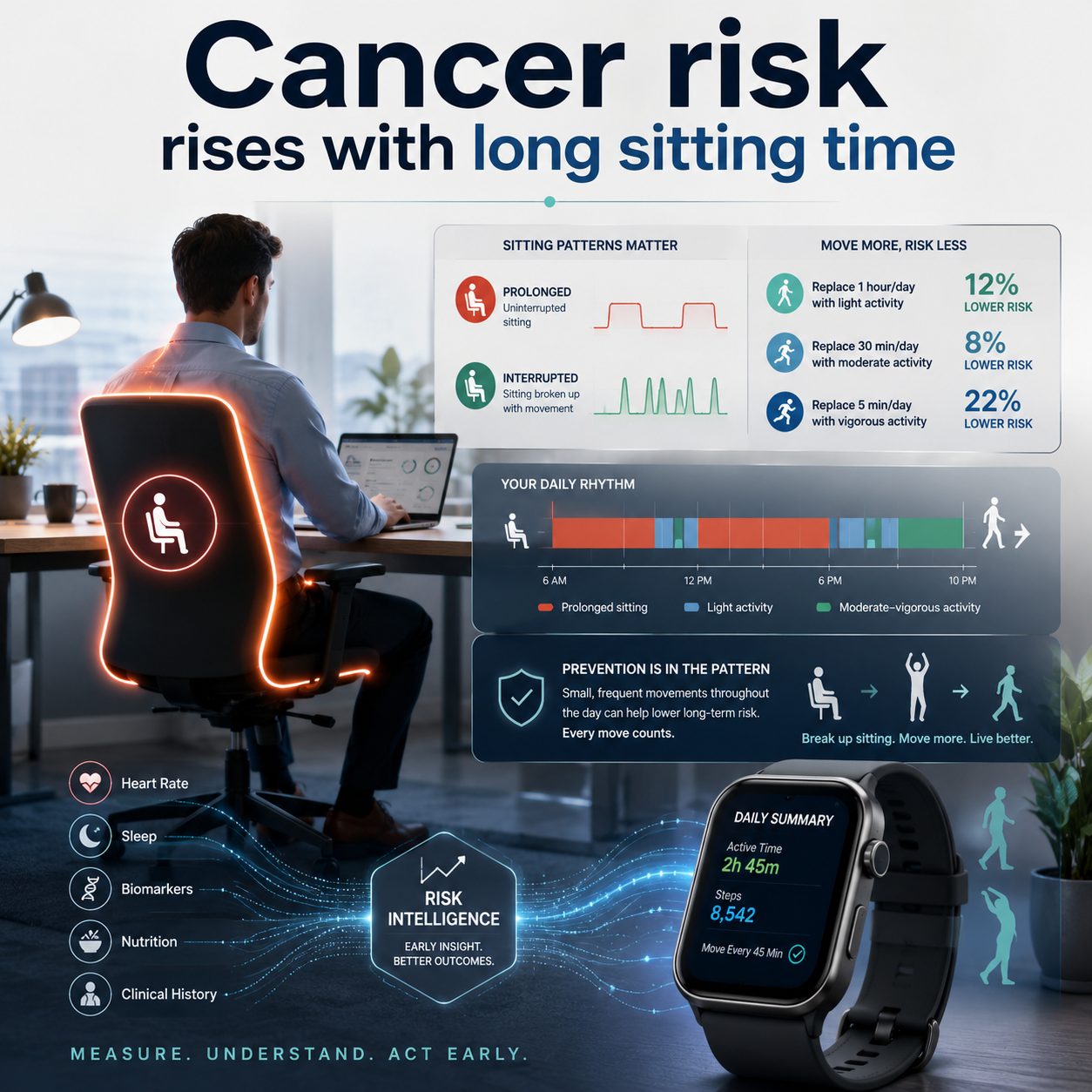
Pattern matters. The study looked not only at total sedentary time, but also at whether sitting came in long uninterrupted blocks or shorter interrupted periods [1].
Light movement matters. Replacing 1 hour per day of prolonged sedentary behavior with light physical activity was associated with a 12% lower hazard of cancer death [1].
Intensity is not the only story. Replacing 30 minutes with moderate activity was associated with an 8% lower hazard, and replacing 5 minutes with vigorous activity was associated with a 22% lower hazard of cancer death [1].
Wearables matter. This kind of research shows why real-world activity patterns can become part of long-term risk intelligence, alongside biomarkers, blood tests, sleep, nutrition, and clinical history [1].
Risk is pattern recognition. The better we understand the invisible rhythms of daily life, the earlier we may be able to spot risk and open a prevention window before symptoms appear.
For me, this is one of the most important shifts in preventive health: the future of health may be hidden in very ordinary moments.
We should ask ourselves: “How does my day accumulate risk?”
That requires measurement, interpretation, and follow-up.
So get a wearable, or set a simple alarm every 45 minutes to remind yourself to move.