Frontier open-source and open-weight LLMs should be heavily regulated
Opinion
Powerful model weights without control create a safety gap that policy cannot close fast enough.
Open Source and Open Weight Large Language Models (LLMs) should be banned and heavily regulated. [1]
Not because openness is “bad”, but because releasing powerful model weights without control creates a safety gap that policy and law enforcement cannot close fast enough. [2]
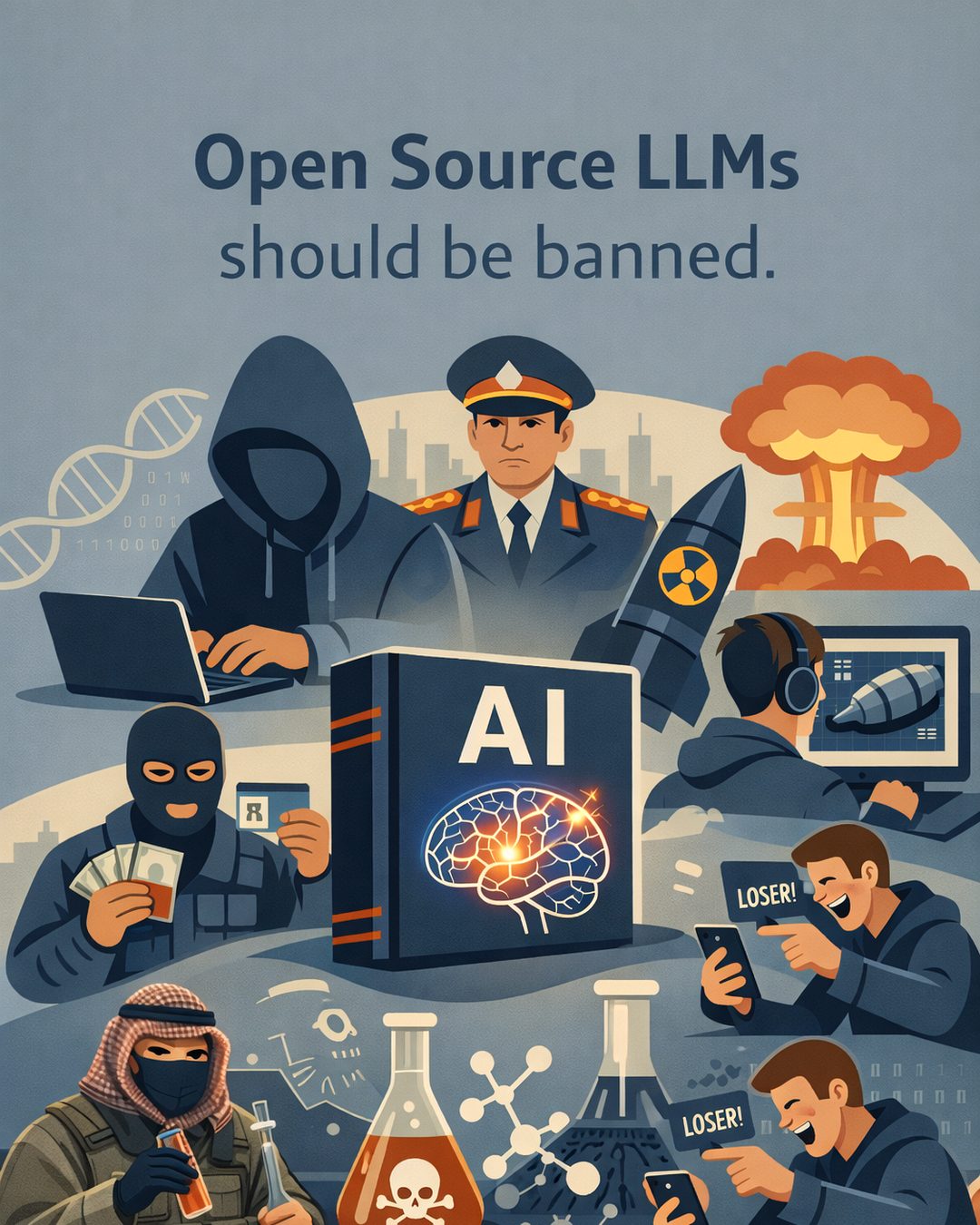
Here is the uncomfortable part: these systems can be misused at scale, both intentionally and unintentionally. [2][3]
- Criminals can use them for identity theft, impersonation, blackmail, and fraud. [2]
- Hackers and cybercrime groups can scale phishing, social engineering, and cyberattacks, especially when safeguards are removed from open-weight models. [2]
- Dictators and state actors can use them for propaganda, censorship, and mass persuasion. [4][5]
- Terrorists and violent extremists could exploit biology-related assistance that lowers barriers to harmful planning. [3][6]
- Criminal networks could use chemistry-related help for illicit drug production or handling dangerous substances. [3]
- Bullies can amplify harassment and targeted humiliation at scale. [2]
We already accept that high-risk capabilities are restricted.
- Nuclear technology is tightly governed under the International Atomic Energy Agency (IAEA) and the Treaty on the Non-Proliferation of Nuclear Weapons (NPT). [7]
- Chemical weapons are banned under the Chemical Weapons Convention (CWC), enforced by the Organisation for the Prohibition of Chemical Weapons (OPCW). [8]
- Chemical and biological precursors are controlled through export regimes like the Australia Group (AG). [9]
- In everyday life, we lock up weapons and keep dangerous products away from children.
Prominent voices have warned about open release of frontier systems.
- Dame Wendy Hall, United Nations adviser on Artificial Intelligence, called open sourcing Artificial General Intelligence (AGI) before regulation “really very scary”. [1]
- Yoshua Bengio, Turing Award laureate, has argued that catastrophic risk justifies restricting access to the most dangerous systems. [6]
- Geoffrey Hinton, AI pioneer, has warned that advanced Artificial Intelligence can be misused and requires serious regulation. [5]
- The United Kingdom Artificial Intelligence Safety Institute (UK AISI) has warned that safeguards can be removed quickly from open-weight models. [2]
- OpenAI has supported banning access to certain People’s Republic of China (PRC) affiliated models on national security grounds. [10]
My take: we should treat frontier open-source and open-weight LLMs like other high-consequence technologies: licensed access, controlled distribution, mandatory evaluation, and accountability.
References
- The Guardian (19 Jan 2024), Wendy Hall on open sourcing AGI
- UK AISI. Managing risks from increasingly capable open-weight AI systems (29 Aug 2025)
- NIST AI 800-1. Updated Guidelines for Managing Misuse Risk for Dual-Use Foundation Models (15 Jan 2025)
- EEAS 3rd Report on Foreign Information Manipulation and Interference (31 Mar 2025)
- Reuters interview with Geoffrey Hinton (5 May 2023)
- Yoshua Bengio. FAQ on Catastrophic AI Risks (24 Jun 2023)
- IAEA overview of the NPT
- OPCW overview of the Chemical Weapons Convention
- Australia Group
- TechCrunch on OpenAI policy proposals regarding PRC-affiliated models (13 Mar 2025)